
John Glenn’s sunset from space
I am honoured to own this original print.
- Flight
- Mercury-Atlas 6 · Friendship 7
- Date
- 20 February 1962
- Orbit
- 3
- Ground elapsed time
- 003:39:41
When the camera went click
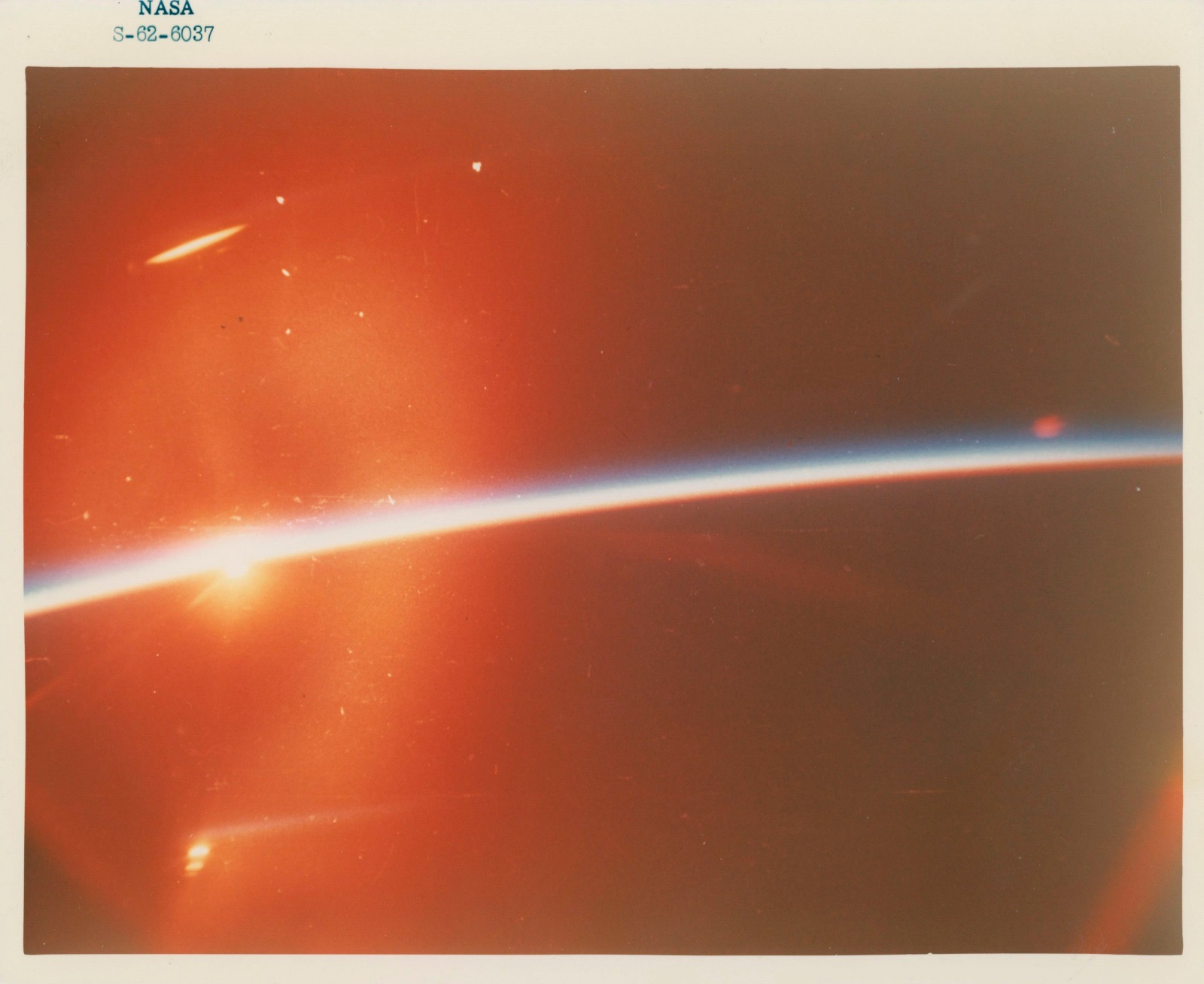
During his third orbital sunset, John Glenn caught the flattening of the solar disk just before the Sun disappeared below the horizon and the thin layer of Earth’s atmosphere against the black backdrop of outer space.
John Glenn · Pilot’s Flight Report
“Some of the most spectacular sights during the flight were sunsets. The sunsets always occurred slightly to my left, and I turned the spacecraft to get a better view. The sunlight coming in the window was very brilliant, with an intense clear white light that reminded me of the arc lights while the spacecraft was on the launching pad. […]
The Sun is perfectly round as it approaches the horizon. It retains most of its symmetry until just the last sliver is visible. The horizon on each side of the Sun is extremely bright, and when the Sun has gone down to the level of this bright band of the horizon, it seems to spread out to each side of the point where it is setting. With the camera I caught the flattening of the Sun just before it set. This is a phenomenon of some interest to the astronomers.
As the Sun moves toward the horizon, a black shadow of darkness moves across the Earth until the whole surface, except for the bright band at the horizon, is dark. This band is extremely bright just as the Sun sets, but as time passes the bottom layer becomes a bright orange and fades into reds, then on into the darker colors, and finally off into the blues and blacks. One thing that surprised me was the distance the light extends on the horizon on each side of the point of the sunset.
I think that the eye can see a little more of the sunset color band than the camera captures. One point of interest was the length of time during which the orbital twilight persisted. Light was visible along the horizon for 4 to 5 minutes after the sunset, a long time when you consider that sunset occurred 18 times faster than normal.”
Friendship Seven · John Glenn on the radio
- 003:37:32
- Friendship Seven. The sun is going down again now. Coming off automatic in yaw, and yawing a little bit to the left to observe it.
- 003:38:05
- Mark, the sun is down.
- 003:38:29
- And can see little or nothing of zodiacal light at the moment.
- 003:39:21
- This is Friendship Seven, flying with yaw handle pulled. Controlling on manual yaw.
- 003:39:41
- The way the horizon looks is a very orange band. Just as the Sun goes down and extends way off either side, probably 45° each side of the sun, comes up into a lighter yellow, then a very deep blue, then a very light blue, on up to the black of the sky.
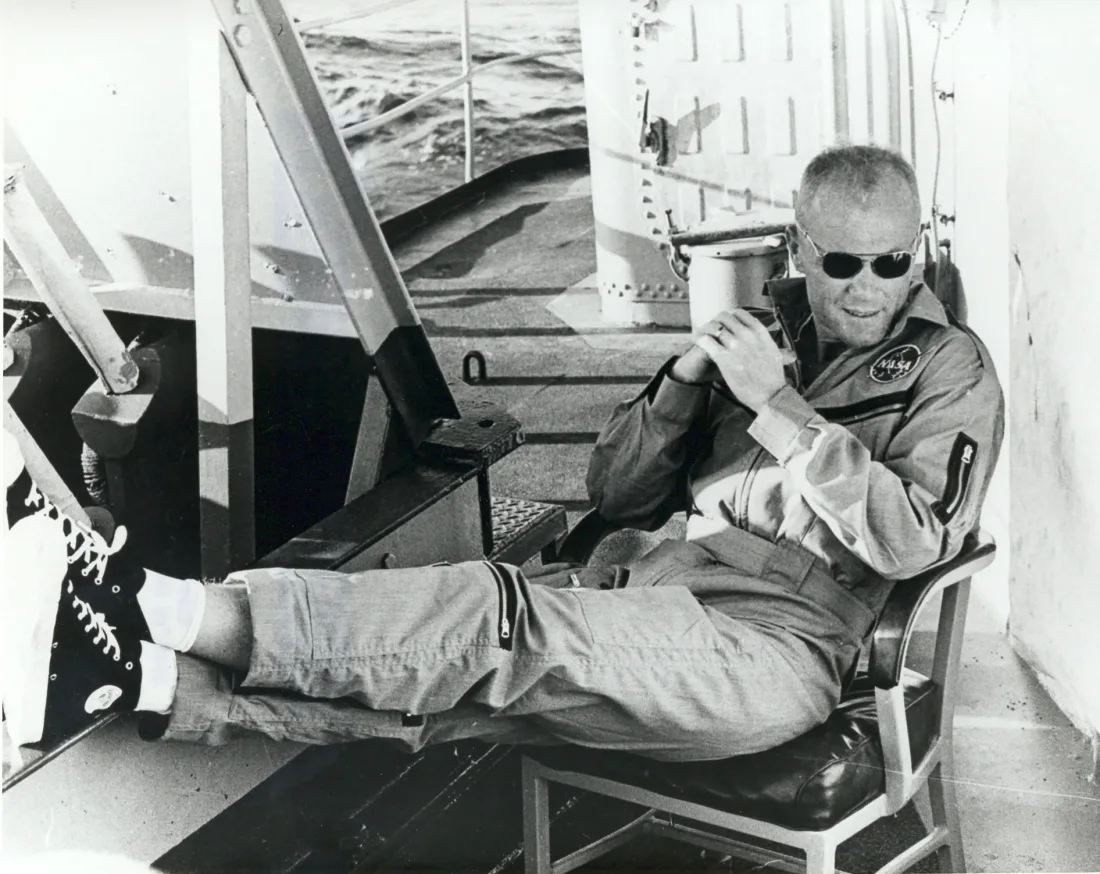
John Glenn“I’ve always been a collector of memorable sunrises and sunsets. I remember sunsets and sunrises from clear back to World War II the way other people may remember seeing a Rembrandt in a museum. I just can’t imagine people oohing and aahing over what I supposed to be great art, and casually ignoring a sunset or a sunrise that is particularly beautiful.”
The print
The catalogue lists the print as First human-taken photograph from space; orbital sunset. The verso bears “A Kodak Paper” watermarks. “NASA S-62-6037” (NASA MSC) is printed in blue in the top margin.
Exhibited
Fly me to the Moon, Kunsthaus Zürich, March–June 2019, and Museum der Moderne Salzburg, July–November 2019. Illustrated in the exhibition catalogue, p. 323, no. 15.